


 Posted by
 —
— Keeping a scrapbook is something that I have been doing nearly all my life.When I was a kid I saved up a bit of pocket money and bought a scrapbook from my local shop. I kept clippings from newspapers and magazines, stickers, labels, action figure card backings that I liked. They were generally about my favourite superheroes or pop stars but they were something that I had great respect for; something that I cherished deeply.
Eventually I stopped doing it as I felt I was too old for it; but my sense of looking for things exciting never left me.When I started on my portfolio prep course for art college, the first week of the course my tutor gave the class an assignment to start a scrapbook. It could be anything....found textures, pieces of clothing, clippings etc. But the main lesson was to take inspiration, visual information and do an investigative study of what you found and how to develop your work and generate creative ideas from your source material.
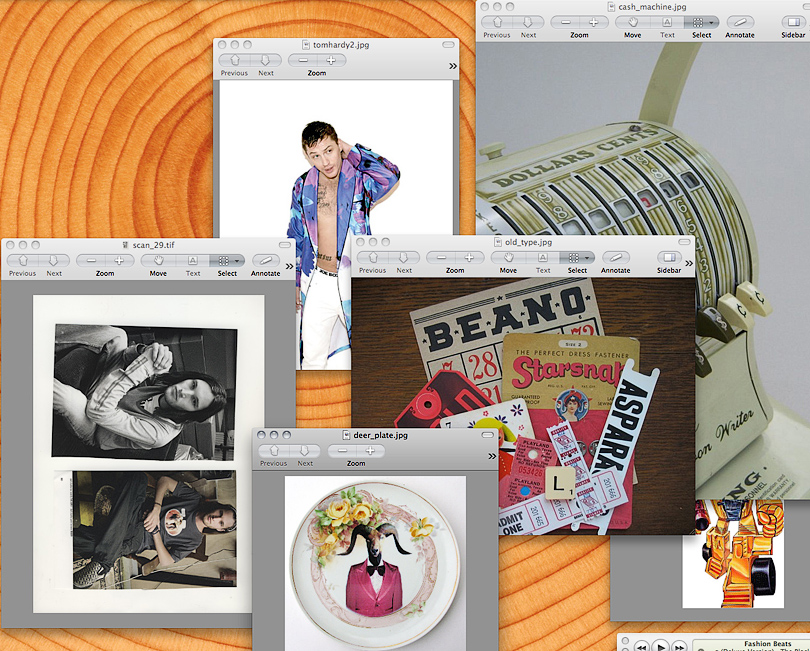
Since leaving college, keeping a scrapbook was definitely something that I wanted to keep up. But since the majority of my work as an illustrator was computer based, I decided to create a digital scrap- book. It was simply a special folder on my iMac that I can drag and drop images, videos and text that I found inspirational and memorable. I create several folders over a space of a few weeks, then merge them into one for folder for each year. I like to keep each folder so I have a reference. I still keep printed material but I actually scan them in on my A3 scanner and drop them into the folders.
My inspiration is quite unusual; I find it very hard to explain to people sometimes.A lot of people ask me ‘Where do you get your ideas from?’ and ‘What motivates or inspires you as an artist?’ and I always mention my scrapbooks! As you can see from the samples, it does range from many different sources. I might be inspired by a famous actor...their presence...their attitude or their looks, so I google images of them and find something to work from. I also like looking through sites like eBay and Etsy because I get great inspiration from vintage objects, fashions and books. It all appears very random but if I have these images to hand then I can get comfortable and start drawing and doodling. I’m also heavily inspired by fashion, especially perfume or clothing advertisements because there is this high level of visual glamour, emotion and attitude all mixed together which is something I always attempt to imput into my illustrations. So I subscribe to fashion labels, blogs and magazines and follow trends and models. and keep any imagery or concepts that I find interesting.
Turn it off, stand up, walk outside!

As an artist I find that spending too much time at the computer can really drain your creativity.Another of my creative processes is to turn off the computer and go interact with the world outside. With the rise in popularity of social networking, blogging and digital media, I can get swept up in tweeting and sitting on Facebook all day. I have found this to be very unhealthy; not just as an artist but as a person too. So I make a conscious effort to get out and get away.What I love about turning off and getting out is the element of unpredictable.You just never know what great ideas will hit when you go walking, grabbing a coffee or going to a museum or a show.You are switching off from your art to an extent but you are not taking a break.You are just refocusing your brain to different things. I walk for a couple of miles a day, I always try to get out of my workspace on a daily basis. I bring my iPhone and take snaps of inspiring and weird things, I discover textures that I could pictures of and bring into my work. I find new places to draw and to photograph or I meet new and interesting people.
I keep all these great images in a folder on my iMac, just to keep as reference. I also create a folder of low resolution images and sync it with my iPhone, so if I’m drawing and I’m away from the workspace I have a visual reference with me at all times.
Charity shops, bookstores, art galleries are again great sources of new and exciting visual information. I try to make a few trips about 3 to 4 times a month to charity shops and second hand markets to source interesting and unusual sources of vintage illustration, art, bric-a-brac and typography. Somethings I buy and keep, others I would just a discreet snap on my iPhone, the important thing to remember is to record these great things that you see while out of the virtual world. For me, the best sources of inspiration are the ones you never set out to find.
Doodle!

Every design brief has a first rough or mockup which is usually an outline to the final work, or ‘scamps’ as some artists call them. But I actually create a scamps for my scamps...if that makes sense.These are very ba- sic drawings, which consist on single lines, random patterns or scripts or phrases that I wish to incorporate into my work.There are essentially doodles, but they are for me the best place to start my work.
I also take visual cues from my photos or scrapbooks when I start my doodles. I work on layout paper or trace paper, because I can overlay my linework and begin to build up an illustration. I like to put experiences into my work; this is a very emotional process from me because these can be both positive and negative experiences. But I believe greatly in artistic expression and this mainly comes from my environment, my social interaction and my relationships.
I work into different colours and layer the trace paper up to see which colours work well together. I also write notes on each page on what materials I wish to use (graphite pencil, watercolour) and whether I can acheive the effect and look I want in traditional media or if I have to work into Photoshop. I scan the important visuals into Photoshop, layer it up and then print it out so I can start to build my final piece. I like to keep a very loose and natural look to my illustrations so I don’t worry too much about mistakes. Doodles are very expressive, you can start to ‘zone out’ and begin to create some exciting shapes and patterns.
Visual Notebook.

An essential piece of kit for any artist, not matter how digitally or traditionally based your work is. A visual notebook is your brain in blank book form. It is your best outlet for creation.Your notebook should partially double as your bookmarker, your phonebook and a smaller scrapbook. Carry your notebook with you everywhere you go, from being beside at your lunch to sitting on a plane.You should always keep it handy. I usually keep an A5 or A6 size spiralbound notebook and a pen stuck to the front, something small and easy that I can flick open and start doodling or writing.
I actually get a tidal wave of ideas and images when I settle down to sleep so I keep it by my bed so I can get all the imagery scribbled down.Also when I’m travelling, I get great inspiration and I also sketch while I’m on the bus or train to work.The objective I find with a visual notebook is to get a skeleton image down to begin with and then you can build up in preliminary work for the illustration. I also write down what colour I will use because it makes or breaks a piece for me. It sounds strange but I love how trashed my notebook looks, it really gives me a sense that I am working, much more than anything I could achieve on a computer.
Digital Scrapbooking.

 BACK
BACK
 Back to News